Design Context
Thursday, 14 January 2016
Dissertation Time Frames
Research Stage (September/October)
-Postmodern Theory
-Postmodernism in Design
-Postmodernism in Editorial Design- Raygun, The Face, Colors (to triangulate traits)
Writing of main body (November, keep adding if needed and refining over time)
Case Studies (December /Jan if needed)
Flaneur
Dazed
i.D
Practical Piece (End of December/ Jan )
Research
Construction
Printing/Binding/Design Boards/Evaluations (Last Week)
-Postmodern Theory
-Postmodernism in Design
-Postmodernism in Editorial Design- Raygun, The Face, Colors (to triangulate traits)
Writing of main body (November, keep adding if needed and refining over time)
Case Studies (December /Jan if needed)
Flaneur
Dazed
i.D
Practical Piece (End of December/ Jan )
Research
Construction
Printing/Binding/Design Boards/Evaluations (Last Week)
Dissertation / Practical Synthesis
The synthesis between my dissertation and practical is very complex and in depth. My dissertation talks about how postmodernism blurred the boundaries between art and design which I accomplished with my work, creating an art piece which is of book pages. The art piece has a grid like a book page, but instead it is a physical grid. This is also true with the 'frame'. One frame is gold representing the ornamental and decorative themes found within postmodernism, whilst the other is black representing the simplicity of modernism. The string work also reflects these themes, with the postmodernism grid being colourful and decorative, whilst the modernist strings are black, representing the uniformity principles of modernism. The structure of the content in the practical reflects themes of both postmodernism and modernism, and traits which are found in contemporary editorial design. The modernist structure is very simple, with left align typography in Helvetica in 2 columns. The postmodernist piece however uses 4 different typefaces, all with postmodern connotations- keedy sans, sabon, minion and memphis. I also had one piece in zapf dingbats as a reference to Carson's typographic decisions in Raygun. The layout hosts content in a variety of different ways, having type reading horizontally and vertically, in different alignments which sometimes overlap image. The images are also grid breaking, both vertical, horizontal and diagonal forcing a more in depth interaction with the audience. I used repurposed wood for a pastiche element, using old repurposed wood, with new paint and new strings, with content printed using modern technology. The frames are small enough to be handled like a book but large enough that the reader would have to physically move to read the content, the physical point of view influencing the understanding of the content.
Dissertation Evaluation
For my dissertation I chose the question 'To what extent has postmodernism influenced contemporary editorial design?' This was because of my interest in editorial design, as well as my ignorance of postmodernism that I wanted to learn more about. The research stage took a huge proportion of my time, researching postmodern philosophy, design theory, influence on graphic design as a whole then finally postmodernism within editorial design. I also had to research modernism so that I had a good foundation of knowledge to build upon - This was critical as without an understanding of modernism, postmodernism is a difficult concept to understand fully. I found the writing process very difficult as critical writing is something I have always struggled with. The main issue was that it was such a broad topic, deciding which information is important and which wasn't became tough. Once the writing on theory and postmodern design was complete, the task became a lot easier with the case studies. Critically analysing contemporary magazines was very enjoyable, and improved my understanding of the construction of publications in the modern age. Along the way, I made notes on key concepts that are found in both modernist publications and postmodern publications, which I could then apply to my practical piece to ensure that a strong synthesis would be present. Numerous conversations with course mates helped a great amount, reflecting on my writing and discussing concepts which would be in my dissertation and practical. I felt that I should have spent a larger proportion of my time refining my final written piece, improving the structure of the content so that it reads more smoothly, however I am confident that the content successfully answered my initial question. The practical piece was stressful as I have never constructed a piece of art before. I built the frame using repurposed wood which became slightly damaged in the process, however I feel like this adds to the human warmth element of the work as it's history can be seen. The stringwork was tough as during the drilling process the wood almost split. I had to then take it to a workshop and set the frames in vices, using a screwdriver instead of a drill to screw the screws in more carefully. With more time I would have liked to print the content in different stocks to further add to the postmodern concepts, but time restraints unfortunately prevented this. If I were to do this process again, I would have managed my time differently, taking a week out of my research stage and using it for a contingency plan, or for dissertation refinement. I would also have experimented with different materials for the practical content. I would've liked to create a larger installation rather than a piece contained within a frame to further the concept of an individuals point of view being key to their understanding of the work. I am happy with the final results, and am proud that I managed to write a successful dissertation even though I was very unconfident with my writing skills.
Friday, 4 December 2015
COP DISSERTATION PRACTICAL
My practical must have a strong synthesis with my dissertation, so it makes sense that whatever I produce is a commentary on modernism/postmodernism through editorial design.
I have come up with a concept where I will produce an art installation that crosses the boundaries of editorial design and art. It will also be linked to my 'living organism' analogy which I have threaded through my dissertation. I will first create a publication using typical modernist design techniques and styles, which I would then deconstruct in some way, possibly by ripping apart each individual element (block of text, image, citations, illustrations etc) and suspending them with string/cable/paper (different materials based on what the content itself is and where it has been sourced from) - the concept being that they are suspended in both time and space but by a flexible means.
It will explore how far a publication can be deconstructed before it no longer becomes editorial design and ventures into fine art. The contents of the installation will be comprised of body copy (my dissertation) in grids, photographs, illustrations, my bibliography and research.
This is in reaction to emigre articles in which Rudy VanderLans claims that anything print that is seemingly new, is merely a variation of older works. However Tibor Kalman, creative director of Colors magazine claimed that ''People haven't started fucking with the printed page in a serious way yet...''. This is what I aim to do. Instead of the deonstruction coming from within the page, the pages and publication itself is deconstructed, exploded similar to Cornelia Parkers exploded shed.
The type itself would be created in a multitude of different ways. Some would be delicate (if the writing itself is somewhat delicate), so it could be handwritten onto tracing paper. Any work which is particularly complex and ornamental would be printed onto a patterned fabric. Whilst elements of my dissertation which I believe to be core to my argument would serve as the living organisms 'spine', which could be laser-cut into wood, perspex or possibly slab.
Where could I construct this? originally I wanted the piece to fill an entire room to showcase the scale of the complexity postmodernism holds, and also to emphasize how some links between arguments are strong and some far fetched. I want everything in the installation to have a purpose and concept, never considering the aesthetic as that consideration would be put into the construction of the original publication.
As for the web, I could construct a web using strings in a similar way to Gabriel Dawe.
I have come up with a concept where I will produce an art installation that crosses the boundaries of editorial design and art. It will also be linked to my 'living organism' analogy which I have threaded through my dissertation. I will first create a publication using typical modernist design techniques and styles, which I would then deconstruct in some way, possibly by ripping apart each individual element (block of text, image, citations, illustrations etc) and suspending them with string/cable/paper (different materials based on what the content itself is and where it has been sourced from) - the concept being that they are suspended in both time and space but by a flexible means.
It will explore how far a publication can be deconstructed before it no longer becomes editorial design and ventures into fine art. The contents of the installation will be comprised of body copy (my dissertation) in grids, photographs, illustrations, my bibliography and research.
This is in reaction to emigre articles in which Rudy VanderLans claims that anything print that is seemingly new, is merely a variation of older works. However Tibor Kalman, creative director of Colors magazine claimed that ''People haven't started fucking with the printed page in a serious way yet...''. This is what I aim to do. Instead of the deonstruction coming from within the page, the pages and publication itself is deconstructed, exploded similar to Cornelia Parkers exploded shed.
The type itself would be created in a multitude of different ways. Some would be delicate (if the writing itself is somewhat delicate), so it could be handwritten onto tracing paper. Any work which is particularly complex and ornamental would be printed onto a patterned fabric. Whilst elements of my dissertation which I believe to be core to my argument would serve as the living organisms 'spine', which could be laser-cut into wood, perspex or possibly slab.
Where could I construct this? originally I wanted the piece to fill an entire room to showcase the scale of the complexity postmodernism holds, and also to emphasize how some links between arguments are strong and some far fetched. I want everything in the installation to have a purpose and concept, never considering the aesthetic as that consideration would be put into the construction of the original publication.
As for the web, I could construct a web using strings in a similar way to Gabriel Dawe.
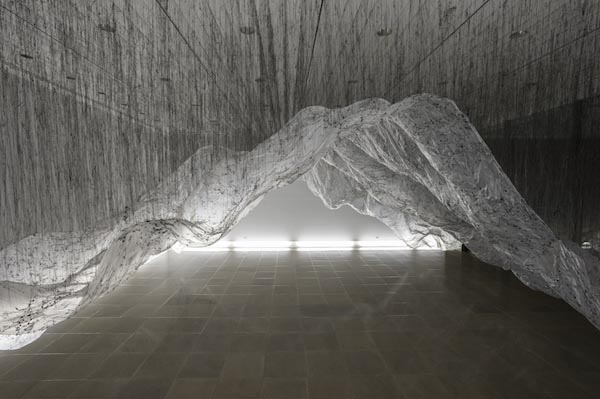
Yasuaki Onishi also produces suspended works using strings, however his strings are used to hang a material, closer to what I am wanting to accomplish.
After consulting with tutors and other students, I have realised that given current timeframes and restrictions regarding possible locations for this installation, I have decided to refine the idea, and instead create an art sculpture/editorial design piece.
Postmodernism from what I can assert from my research is an incredulity towards meta-narratives, involving the blurring of boundaries between high and low culture, as well as types of craft. I will be creating a work which is composed of 2 frames attached by hinges, reimagining the 'book' concept. It will stand at about a meter high, with the intention that the audience will have to physically move around the object in order to understand the information better.
DISSERTATION CONTENT
“Simplifying
to the extreme, I define Postmodernism as an incredulity towards
metanarratives.”
-Jean-Francois
Lyotard
The postmodern philosophy is almost
impossible to define. Simon Malpas addresses this paradoxical issue in his book
‘The postmodern (the new critical idiom)’, where he says that finding a ‘simple
and uncontroversial’ definition for the term ‘postmodern’ is impossible, given
that the clear and concise process of identification required for such a label
is in fact one of the key elements of rationality which postmodernism attempts
to challenge.
One
of the first philosophers to explore postmodernism to it’s full potential was
Friedrich Nietzsche. Nietzsche disagreed with Kant’s theory of transcendental
categories, and instead suggested that truth is nothing but an illusion.
Stitzel (2005) concurs with this sentiment, saying that ‘’postmodern philosophy
encompasses that all ‘truth’ is relative to the individual, that it is, essentially,
whatever you make.’’
The
international avant-garde movement of Dada was a precursor to postmodernism.
With it’s anti-art concept it didn’t care for aesthetic, and intended to offend
and question the existing sensibilities of the art world. Suddenly art wasn’t
merely an end in itself, but instead as Hugo Ball put it, it became
instead ‘’an opportunity for the true perception
and criticism of the times we live in."
Postmodernism
blurs the lines between high and low culture. It believes that societal and
cultural hierarchies are false and unstable. With modern mass communication and
the vast amount of different subcultures and styles, it realises the ease in
which people can move fleetingly between different cultural experiences. It has
also been argued that the postmodern condition is grown from the economic shift
towards an international merging of culture and cultural goods.
Charles
Jencks, a notable architectural theorist, says of postmodernism that it is
fundamentally the eclectic mixture of any tradition with that of its immediate
past: it is both the continuation of modernism and it’s transcendance. Jencks
sorted postmodern attributes into Straight Revivalism, the idea of the creation
of something new which seems old, using nostaligia to communicate, and Radical
Eclectism, which mixes up styles and references in an ironic way.
Postmodernism
uses bricolage, parody, pastiche and appropriation extensively, referencing
past movements, events, designs, often satirically.
The
McCoys teachings emphasized the building of meaning between the graphic design
and it’s audience, forming a dialogue with the audience rather than a
monologue, believing that it was a ‘truer’ form of communication.
‘’The constitutive rules
that govern a particular kind of craft activity are not external to it. These
rules are the activity: they give it its own internal logic, which the
practitioner must follow, and, taken together, they add up to a body of
knowledge. To divorce them from the activity would be to destroy it.’’
(Poyner.R, 2003, p16)
The
lack of rules associated with postmodernism is massively problematic in the
sense that without governing rules, a standard of quality is impossible to
establish to review the works against. This provoked an influx of poor design created
by designers unfamiliar with design theory, under the guise of it being
postmodern.
Although
a target market is by definition more refined, the postmodern view of every
individual having their own viewpoint must be abandoned as the content could not
be tailored unless the magazine had a ‘prosumer’ marketing strategy, as many
online platforms now are starting to do.
John
Lewis in his book ‘Typography Basic Principles’ (1963) during a chapter named
‘Rules are made to be broken’, explains that before you begin breaking
established rules, you should first learn what they are, that there are in fact
meta-rules to breaking the rules.
The most notable accomplishment
of postmodernism was it’s critical questioning of existing themes and the
modernist styles which has stagnated and become overused due to a lack of
credible contest from other movements. The design landscape had atrophied after
existing for so long without this critical reexamining, until postmodernism
began exercising and reinvigorating it with fresh ideas about what the consumer
was both capable of, and what their role in the process was, turning from
spectator to participant. This exercising stretched and tore at design world,
and over time through refinement it healed to be stronger than before.
The postmodern philosophy then
rejected the idea of the metanarrative, believing that communicating is
accomplished more successfully by allowing typography and imagery to be as
expressive as the content itself. It also allowed for decoration and
ornamentation, pushing the boundaries between what can be considered graphic
design and fine art. It also attacked other boundaries such as the one which
divides high and low culture, in an attempt of unification, generating
plurality in design.
Instead of a creative
landscape, what exists can be considered a creative living organism.
Postmodernism acts as a parasite, necessary to the ‘survival of the fittest’
evolutionary process. It both attacks the organism, but also couldn’t exist
without it. What the current mainstream design beliefs were, which at the time
was modernist, act as an immune system, which either attempts to neutralize the
threat or to assimilate it. As the immune system became stagnant and
vulnerable, the postmodern parasite attacks, although unnoticed and undefended
against until it became widespread enough that it was damaging to it.
Eventually, the mainstream adopted certain strong elements of postmodernism,
the ones which were commercially viable, and killed off the traits which were
too outlandish and subjective to be used. The postmodern traits which survived
and were absorbed by the living organism gave work a human warmth element which
consumers enjoy and were thus commercially successful to corporations.
By 1977, Punk Rock was a hugely
influential movement which influenced culture and design massively for the next
few decades. The anarchic attitude echoed the feelings of past Dada artists,
longing for the tearing up of rules and the creation of new thought provoking
works.
he
incendiary pages of Ray Gun magazine inflamed the eyes and minds of
countless young designers who sought to tap into the freedoms unlocked by his
bold new style.
(Lupton.E,
2014. Aiga.org)
“Typography
conveys meaning. The kinds of letters that you use say something about what
you’re trying to project. They can portray hipness, they can portray authority,
they can convey playfulness, they can convey power.” – David Carson
From 1981 up
until 1986, Neville Brody was appointed Typographer, Graphic Designer and Art
Director of the magazine. His work was revolutionary, clearly channeling his
interest in Dada, futurism and constructivism into his designs. His use of
typography was groundbreaking and had a similar effect as Carson’s work at
Raygun, forming an esoteric aura around the magazine exclusively for the
fashionable youth.
MODERNISM
The agenda of Modernism was to create design that improved the
world through work which projected the ideas of fairness and equality. After
world war 2, ‘utopian fever’ gripped the world inspiring designers worldwide to
attempt to create works which transcended personal tastes, communicating to
everyone, unifying the audience.
The
sans-serif typeface Helvetica, designed by Max Miedinger in 1957, is a perfect
example of modernist principles. Infamous for its absence of connotations, it
is completely void of style or flourishes, designed using a simple geometric
grid, and was at it’s conception completely neutral. This ‘non-style’ however
became style in and of itself after mass usage by corporate advertisers and
branding.
“Perfection is achieved,
not when there is nothing left to add, but when there is nothing left to
remove.”
Joseph
Muller-Brockmanns ‘Grid Systems in Graphic Design’ helped to spread the use of
grid systems and typographic structures, which lead to typographic hierarchies
being further developed in a scientific manner. Designers of the modernist
movement believed that typography should be able to perform it’s job as a
monologue, with clarity and universality. That typography should be unobtrusive
and shouldn’t be expressive, acting merely as the instrument of expression.
Beatrice
Warde explains modernisms fundamental rules and unobstructive nature with her
1930 essay, ‘The Crystal Goblet’. it uses an analogy of two goblets, one made
of solid gold and intricately patterned and the other crystal clear, with no
ornamentation; both filled with wine. The true connoisseur of wine would choose
the latter, enjoying the full experience of the goblet’s content rather it’s
decoration and display. The content can communicate more purely as now the
consumer isn’t distracted or obstructed by decoration.
It can be concluded that
modernist design put form before function, making the design a vehicle for
expression and communication, rather than being expressive itself.
Baudrillard describes
modernism’s fatal flaw as it’s ‘’development of theories, in which the
excessive, fruitless search for total knowledge lead almost inevitably to a
kind of delusion.’’ This delusion being the ignorance of micro narratives.
Both Vignelli’s subway map and
Miedinger’s Helvetica are both of Swiss design influence, a style favouring
simplicity, legibility and objectivity, thus being the pinnacle of the
modernist design. Also known as International Style, it bordered on minimalism,
championing uniformity, geometry and the utilization of white space.
One of the most influential
modernist designers Massimo Vignelli works in many different design fields from
graphic design to interior design. The 1972 New York City transit map [FIGURE
2] is arguably his most famous work, which is undoubtedly of modernist design.
The map used the typeface Helvetica (before it’s staining corporate
connotations), as well as a geometric colour-coded layout of the subway. The
extremely simple design isn’t geographically accurate, however the structure
Vignelli used is remarkably easy to understand and use, far more so than it’s
geographically accurate predecessors.
\
Friday, 27 November 2015
CoP Dissertation Research
Modernism/Modernity
|
Postmodern/Postmodernity
|
Master Narratives and metanarratives of history, culture and national identity as accepted before WWII (American-European myths of progress). Myths of cultural and ethnic origin accepted as received.
Progress accepted as driving force behind history. | Suspicion and rejection of Master Narratives for history and culture; local narratives, ironic deconstruction of master narratives: counter-myths of origin. "Progress" seen as a failed Master Narrative. |
| Faith in "Grand Theory" (totalizing explanations in history, science and culture) to represent all knowledge and explain everything. | Rejection of totalizing theories; pursuit of localizing and contingent theories. |
| Faith in, and myths of, social and cultural unity, hierarchies of social-class and ethnic/national values, seemingly clear bases for unity. | Social and cultural pluralism, disunity, unclear bases for social/national/ ethnic unity. |
| Master narrative of progress through science and technology. | Skepticism of idea of progress, anti-technology reactions, neo-Luddism; new age religions. |
| Sense of unified, centered self; "individualism," unified identity. | Sense of fragmentation and decentered self; multiple, conflicting identities. |
| Idea of "the family" as central unit of social order: model of the middle-class, nuclear family. Heterosexual norms. | Alternative family units, alternatives to middle-class marriage model, multiple identities for couplings and childraising. Polysexuality, exposure of repressed homosexual and homosocial realities in cultures. |
| Hierarchy, order, centralized control. | Subverted order, loss of centralized control, fragmentation. |
| Faith and personal investment in big politics (Nation-State, party). | Trust and investment in micropolitics, identity politics, local politics, institutional power struggles. |
| Root/Depth tropes. Faith in "Depth" (meaning, value, content, the signified) over "Surface" (appearances, the superficial, the signifier). | Rhizome/surface tropes. Attention to play of surfaces, images, signifiers without concern for "Depth". Relational and horizontal differences, differentiations. |
| Crisis in representation and status of the image after photography and mass media. | Culture adapting to simulation, visual media becoming undifferentiated equivalent forms, simulation and real-time media substituting for the real. |
| Faith in the "real" beyond media, language, symbols, and representations; authenticity of "originals." | Hyper-reality, image saturation, simulacra seem more powerful than the "real"; images and texts with no prior "original". "As seen on TV" and "as seen on MTV" are more powerful than unmediated experience. |
| Dichotomy of high and low culture (official vs. popular culture). Imposed consensus that high or official culture is normative and authoritative, the ground of value and discrimination. | Disruption of the dominance of high culture by popular culture. Mixing of popular and high cultures, new valuation of pop culture, hybrid cultural forms cancel "high"/"low" categories. |
| Mass culture, mass consumption, mass marketing. | Demassified culture; niche products and marketing, smaller group identities. |
| Art as unique object and finished work authenticated by artist and validated by agreed upon standards. | Art as process, performance, production, intertextuality. Art as recycling of culture authenticated by audience and validated in subcultures sharing identity with the artist. |
| Knowledge mastery, attempts to embrace a totality. Quest for interdisciplinary harmony. Paradigms: The Library and The Encyclopedia. | Navigation through information overload, information management; fragmented, partial knowledge; just-in-time knowledge. Paradigms: The Web. |
| Broadcast media, centralized one-to-many communications. Paradigms: broadcast networks and TV. | Digital, interactive, client-server, distributed, user-motivated, individualized, many-to-many media. Paradigms: Internet file sharing, the Web and Web 2.0. |
| Centering/centeredness, centralized knowledge and authority. | Dispersal, dissemination, networked, distributed knowledge. |
| Determinacy, dependence, hierarchy. | Indeterminacy, contingency, polycentric power sources. |
| Seriousness of intention and purpose, middle-class earnestness. | Play, irony, challenge to official seriousness, subversion of earnestness. |
| Sense of clear generic boundaries and wholeness (art, music, and literature). | Hybridity, promiscuous genres, recombinant culture, intertextuality, pastiche. |
| Design and architecture of New York and Berlin. | Design and architecture of LA and Las Vegas |
| Clear dichotomy between organic and inorganic, human and machine. | Cyborgian mixing of organic and inorganic, human and machine and electronic. |
| Phallic ordering of sexual difference, unified sexualities, exclusion/bracketing of pornography. | Androgyny, queer sexual identities, polymorphous sexuality, mass marketing of pornography, porn style mixing with mainstream images. |
| The book as sufficient bearer of the word. The library as complete and total system for printed knowledge. | Hypermedia as transcendence of the physical limits of print media. The Web as infinitely expandable, centerless, inter-connected information system. |
The commercial vernacular (a recurring strategy in Cranbrook graphics) sits uneasy with the hermetic, design for designers status of so many school projects.
- Eye Magazine, The Academy of the deconstructed design. Spring 1991. No3.V1
Nobody worries about working for ‘the man’, instead now everyone wants to be ‘the man’.
is this arrogance of the graphic designer?
If no standard of quality is being set, then the work being produced becomes entirely subjective, unable to be scrutinized against a set of ideals. This then surely means that the
design instead becomes art.
Developed theories in which the excessive, fruitless search for total knowledge lead almost inevitably to a kind of delusion
- Baudrillard on Modernism
Postmodernism isn’t a style, it’s an idea about the time we’re living in, a time that is full of complexities contradictions and possibilities. It is an unwieldy and troublesome paradigm. However I think it is preferably to the reassuring limitations of modernism.
- Keedy
EMIGRE- POYNER
Here [Britain], Modernism is being recuperated as style: small sizes of Helvetica, acres of white space, asymmetrical compositions. To you, I know, the style signifies an utterly bankrupt corporate Modernism. In Britain, it can still - just about - signify progressive intention, at least in the aesthetic sense. Actually, in the mid-eighties it seemed rather fresh, and it hasn't gone away in the nineties. Perhaps in Britain it's best thought of as a kind of revival, a Neo-Modernism. Modernism never "took" here with the depth and rigor of the continent. Certainly, looking back, there were designers like Herbert Spencer with Typographica magazine and Anthony Froshaug at Central School in the fifties, who were influenced by pre- and postwar Modernism. I don't want to say Modernism was "diluted" in British commercial work, because that sounds so dismissive, but it was a much quieter, more gentlemanly, less dynamic brand of Modernism. Eventually it petered out. No one in mainstream practice was talking about Modernism in the eighties. That's why when 8vo suddenly put out Octavo magazine in 1986 and started to produce in a very assertive Modernistic style, to strike postures, issue manifesto-like statements, and declare the unacceptability of certain typefaces, that struck people here as extraordinary and radical.
The pages of Eye probably play out the unresolved tensions of modernism and Postmodernism in graphic design. I have to personalize this and say that it's a tension I feel in myself. I recognize the "Postmodern condition," and that I'm part of it. I can walk out of here, after we finish the interview, to Virgin Records, and every conceivable form of world music or film is there for the taking. That kind of instant availability of culture in the home changes everything. Not so long ago we didn't have it, and within a short period of time, we do. What Baudrillard found so obscenely fascinating is just a foretaste of what we've got coming to us through the international web of media. You, too, can have 500 channels on your TV. And I'm a consumer like everyone else, so I buy the products and float in this sea of Postmodern possibilities.
The problem I have with Postmodernism is the relativism and nihilism that follows it. At times it seems as though the only "freedom" we can all agree on now is the freedom to consume. I have a strong sense of a younger self living in what felt like, broadly speaking, a Modernist world, with a belief in progress, a sense of the "perfectibility" of people and systems. The cultural ideas that were important to me when I was younger came from movements like Surrealism and Existentialism, which were to do with the potential of the human imagination and how we should live. I come out of this with a feeling that Postmodernism may be our condition, but it's not enough. The human heart needs more. We may be living in a consumer paradise, but for most people in the world the fundamental problems have not been solved. So I recognize what you say; that there is, at times, in the way I write and the areas of design that interest me, a split between those two areas of thinking - an acknowledgement of one, and maybe a hankering after the other.
EYE MAGAZINE:
Interview
Tibor Kalman’s art direction of Interview is a measure of the degree to which the designer with wit can become an active participant in the editorial process, creating a visual journalism which not only projects, but also determines the content of the magazine. This process includes both the ‘packaging’ of otherwise routine editorial material and the production of thematic issues in which text and image are united in formal and conceptual execution. In Interview, the personality of the interviewee is expressed – critically – in the construction of pull quotes and opening spread, while visual unity is achieved by constantly repeating the shape of images in concrete typographic form. The carefully considered commentary provided by the design is achieved with a minimum of typographic variation, the maxim being that it’s not the typeface you use – it’s the way that you use it. Nevertheless, there are similarities between Kalman’s literary approach to editorial design and that of his predecessor, Fabien Baron. Both adopted a certain theatricality played out within a sparing design system. But where Kalman attacks the reader primarily with language, Baron treated headline letterforms as an opportunity for abstract type constructions. Every article was developed as a succession of glamorous visual dramas, and was divided with extreme formalism into headline, stand-first and text spreads. The beautiful simplicity which Baron had developed in the Italian edition of Vogue was well suited toInterview’s commissioned art features, and also provided the magazine with a powerful thematic glue.
i-D
i-D has always prided itself on staying one step ahead of its readers and this attitude extends to its design. ‘To know what’s right now you need to know what was right last week,’ says Stephen Male, art editor / director since 1987. While The Face, after Brody, experienced a long spiral of decline in editorial conception and graphic impact, i-D has recreated itself with utmost unprecedented regularity, to become one of the most accomplished magazines of the last ten years. Page sizes and formats have varied and the magazine’s treatment of typography, photography and page layout – based on the try-anything ‘instant design’ aesthetic of its founder, first designer and editor in chief Terry Jones – has mutated in accordance with its apprehension of the prevailing mood. Throughout the acid house party / Ecstasy era, i-D’s identity was dominated by colour-saturated trash graphics and a set of typefaces, such as Eurostyle, that had not seen reputable service for years, if ever. Its current shattered-typewriter look is monochromatic and austere, restoring a sense of flatness to the page and reality to the reader. i-D’s design strength stems from its conceptual clarity. Editorially, the magazine has never abandoned its initial desire to document the mores and styles of youth culture, whatever form they might take. Far from acting as constraints, simple ideas like the use of the winking cover-girl and the insistence on an issue theme (‘The life and soul of an issue’, ‘The dangerous issue’) have created a framework for creativity, while ensuring a consistent identity, whatever innovations the magazine’s designers attempt.
Beach Culture
Beach Culture, designed by David Carson, documents the lifestyle and outlook of a precise demographic group located culturally across America, rather than geographically along a strip of coastline. To judge by its letters page, its biggest readership would appear to be in the Midwest, 1500 miles from the nearest wave. Knowing that it isn’t so much the subject matter that counts as the editorial attitude, the magazine’s content skitters erratically between avant-garde art and surfing. What matters above all is the intimacy of the relationship between the title and its readers; the confidence that this closeness engenders allows Beach Culture’s editor and designer to take risks and leader their audience into new and uncharted territory. Carson has largely dispensed with page numbers, the contents page is indecipherable and headlines are dismembered with deconstructive abandon. Such an approach would be commercial suicide outside the narrow subculture enclave inhibited by Beach Culture and similarly intentioned magazines, but to Carson’s readers impenetrability would seem to be a source of satisfaction: presumably because it helps to keep outsiders out. Sceptics say the magazine has been rendered unreadable because it wasn’t worth reading in the first place, but is this a matter for the designer to decide? Beach Culture demands a critical response because it applies typographic ideas more familiar from Cranbrook Academy of Art student projects with a limited circulation to an internationally distributed magazine. Carson achieves a kind of scrambled coherence, but Beach Culture’s legacy is unlikely to be positive, as its mannerisms are copied and applied in situations where they clearly do not belong.
For, according to the standard reading, postmodernism was fickle and ironic, obsessed with style for its own sake. Where modernism was about high-minded notions such as essence and truth to materials, perhaps even a social agenda, postmodernism was about surfaces and signs. As Fredric Jameson put it in his brilliant Postmodernism: Or, the Cultural Logic of Late Capitalism, "it is like the transition from precious metals to the credit card".
The british critic Peter Dormer argues that the ‘constitutive rules’ that govern a particular kind of craft activity are not external to it. These rules are the activity: they give it it’s own internal logic, which the practitioner must follow, and, taken together, they add up to a body of knowledge. To divorce them from the activity would be to destroy it. Graphic Design without rules would cease to be Graphic Design and this is even more the case with typography
Print magazine, 1990s - Triumph of the corporate style
striking homogeneity in the examples in the examples of design and advertising, company literature produced by corporations such as Mobil, Exxon, North American Rockwell and Aristar were orderly, well structured, undeniably clear, but totally predictable and lifeless in it’s use of watered down modernist forms.
‘’It was a period where security and safety replaced risk as the dominant selling tool’
Play and Dismay in ‘Postmodern Graphics’ quotes a senior designer from New York - ‘Graphic Design is not an opportunity to advance art forms.’’
Memphis Group - ‘’Communication - True communication - is not simply the transmission of information...communication always calls for an exchange of fluids and tensions, for a provocation, and a challenge. They also suggest that the designer shouldn’t attempt to ‘know what people need’, but instead to ‘guess what people want’.’’
Kalman - Kalman’s antidote to corporate compromise is work for what he calls his own ‘private audience’. This attitude towards design however is postmodernism’s downfall. The design world is commercial by nature, and by constricting the audience from public to private
Metanarratives and Plurality must be explained within the first chapter.
Plurality within culture - when smaller groups within a larger society maintain their unique cultural identities, and their values and practices are accepted by the wider culture provided they are consistent within the wider laws of the wider society.
Anekantavada - Blind men and the Elephant - In this story, each blind man felt a different part of an elephant (trunk, leg, ear, etc.). All the men claimed to understand and explain the true appearance of the elephant, but could only partly succeed, due to their limited perspectives.
A group of blind men heard that a strange animal, called an elephant, had been brought to the town, but none of them were aware of its shape and form. Out of curiosity, they said: "We must inspect and know it by touch, of which we are capable". So, they sought it out, and when they found it they groped about it. In the case of the first person, whose hand landed on the trunk, said "This being is like a drain pipe". For another one whose hand reached its ear, it seemed like a kind of fan. As for another person, whose hand was upon its leg, said, "I perceive the shape of the elephant to be like a pillar". And in the case of the one who placed his hand upon its back said, "Indeed, this elephant is like a throne". Now, each of these presented a true aspect when he related what he had gained from experiencing the elephant. None of them had strayed from the true description of the elephant. Yet they fell short of fathoming the true appearance of the elephant.
Venturi's second book, Learning from Las Vegas (1972) further developed his take on modernism. Co-authored with his wife,Denise Scott Brown, and Steven Izenour, Learning from Las Vegas argues that ornamental and decorative elements “accommodate existing needs for variety and communication”. Alex Todorow in one of his essays, A View from the Campidoglio, to that effect when he says that:
When [he] was young, a sure way to distinguish great architects was through the consistency and originality of their work...This should no longer be the case. Where the Modern masters' strength lay in consistency, ours should lie in diversity.
Postmodernism with its diversity possesses sensitivity to the building’s context and history, and the client’s requirements. The postmodernist architects often considered the general requirements of the urban buildings and their surroundings during the building’s design. For example, in Frank Gehry's Venice Beach House, the neighboring houses have a similar bright flat color. This vernacular sensitivity is often evident, but other times the designs respond to more high-style neighbors. James Stirling'sArthur M. Sackler Museum at Harvard University features a rounded corner and striped brick patterning that relate to the form and decoration of the polychromatic Victorian Memorial Hall across the street, although in neither case is the element imitative or historicist.
This contrasts against the modernist view in which the observer is essentially omniscient, able to see the entire text from a single viewpoint- that there is one ‘meta-truth’ to be accessed rather than an infinite amount of ‘micro-truths’.
Gianni Vattimo formulates a postmodern hermeneutics in The End of Modernity (1985, in English 1988 [1985]), posing the question of postmodernity as a matter for ontological hermeneutics. Instead of calling for experimentation with counter-strategies and functional structures, he sees the heterogeneity and diversity in our experience of the world as a hermeneutical problem to be solved by developing a sense continuity between the present and the past.
There are several characteristics which lend art to being postmodern; these include bricolage, the use of words prominently as the central artistic element, collage, simplification, appropriation, performance art, the recycling of past styles and themes in a modern-day context, as well as the break-up of the barrier between fine and high arts and low art and popular culture.[1][2]
In the early 20th century Marcel Duchamp exhibited a urinal as a sculpture. His point was to have people look at the urinal as if it were a work of art, because he said it was a work of art. He referred to his work as "Readymades". The Fountain, was a urinal signed with the pseudonym R. Mutt, that shocked the art world in 1917. This and Duchamp's other works are generally labelled as Dada. Duchamp can be seen as a precursor to conceptual art. It is questionable, to some, whether Duchamp—whose obsession with paradox is well known—can be called postmodernist on only the grounds that he eschews any specific medium, since paradox is not medium-specific, although it arose first in Manet's paintings.
Has Postmodernism left a noticeable imprint on contemporary editorial design?
Why are postmodernist attributes still visible (if so) - What is it about Postmodernist attributes that are attractive in a contemporary market?
Have these attributes been appropriated / subverted simply aesthetically or conceptually too?
Who dictates editorial design? Consumer or Art director - the relationship between consumer and creator
When does the aesthetic and art direction become the content (eg raygun etc), is it then a piece of art?
Skeleton Plan
INTRO (500words)
- Explanation of dissertation and Methodology
- A brief overview of modernism and its key principles. Look at Helvetica as an example of modernist typography, and vignelli as a modernist icon. Explain why I am not researching punkzines (not created by designers/not classed as design).
CHAPTER ONE - POSTMODERN THEORY (2200words)
- What the postmodernists philosophy is
- Outline what postmodernism uses - parody/pastiche/reappropriation/views of no rules/objection of metanarratives
- Signs, signifiers and surface
- How the postmodern philosophy affects design
- Triangulation of different sources, arguing the value of postmodernism (Emigre, Cranbrook, New Modernisms, Rick Poyner, Derrida,
- Creative Landscape Living organism analogy
- Suggest what the new post-postmodern term would be (altermodern,supermodern,digimodern)
CHAPTER TWO - POSTMODERN TRAITS DERIVED FROM PoMo theory
Cranbrook / iD / Face / Raygun / Memphis / Punkzines (2200words)
- Katherine McCoy and Cranbrook at the forefront of postmodernism
- Critics of postmodernism and McCoy’s Cranbrook
- The breaking of rules / Carson’s ignorance of them
- Memphis design
- Learning from las vegas analysis - the city of pastiche
- The death of postmodernism / it’s absorption into the metanarrative
CASE STUDIES
- Analyse key postmodern works in editorial design, finding key traits which are recurring in all 3 magazines. (Experimental Type, Rejection of grid, Irony/Parody, pastiche)
- iD (pastiche), pop (type, pastiche), flaneur (experimented type) , [dazed] (rejection of grid)
- Analyse contemporary editorial works, establishing which postmodern traits survived modernisms retaliation
- In depth data analysis of each contemporary work, why they utilized the postmodern traits that they did
The absorption of postmodern traits is due to the commercially ran world, the traits that remained were trendy enough to be commercially viable whilst the rest faded into obscurity. The commercially fueled living organism grows stronger.
The Designer as author-
Michael Rock
Foucault-
early sacred texts authorless, serves as a kind of authentications
scientific texts at last after renaissance demanded authorship
this reversed by 18th century, literature was authored, scientific became anonymous objectivity
once authors started being punished for their writing, text became transgressive. author and text linked firmly.text became private property. critical theory could then be applied. as science texts were unauthored they became not as authored texts but as discovered truths.
post structuralists criticise prestige attributed to the figure of the author. authors intentions to the internal workings of the writing. not what it means, but how. ‘the birth of the reader must be at the death of the author’ barthes.
faucoult asks what difference does it make who is speaking?
the notion that a text is a line of words that releases a single meaning, the central message of and author/god is overthrown.
PoMo turned on a fragmented and schiz decentering and dispersion of the subject noted fred jameson. the notion of a text skewed from the direct line of communication between sender and receiver. free floating element in a field of possible significations.
katherine mccoy prescient image of designers moving beyond problem solving and by authoring additional content and a self conscious critique of the message...adopting new roles associated with art and literature. has often been misconstrued. rather than trying to incorporate theory into their methods of production, many deconstructivist designers illustrated barthes image of reader based text. a tissue of quotations drawn from innumerable centres of culture. by scattered fragments of quotations across the surface o their authored posters and book covers. the dark implications of barthes theory note ellon lupton and j.abbott miller were fashioned into a romantic theory of self expression.
after years of faceless facilitators, designers were ready to speak out. some eager to discard internal affairs of formalism. by 1970s the scientific approach that had held sway for decades, exmplified by the rationalist ideology that spreached strict adherance to an external grid. muller brockman evocation of the
Subscribe to:
Comments (Atom)